
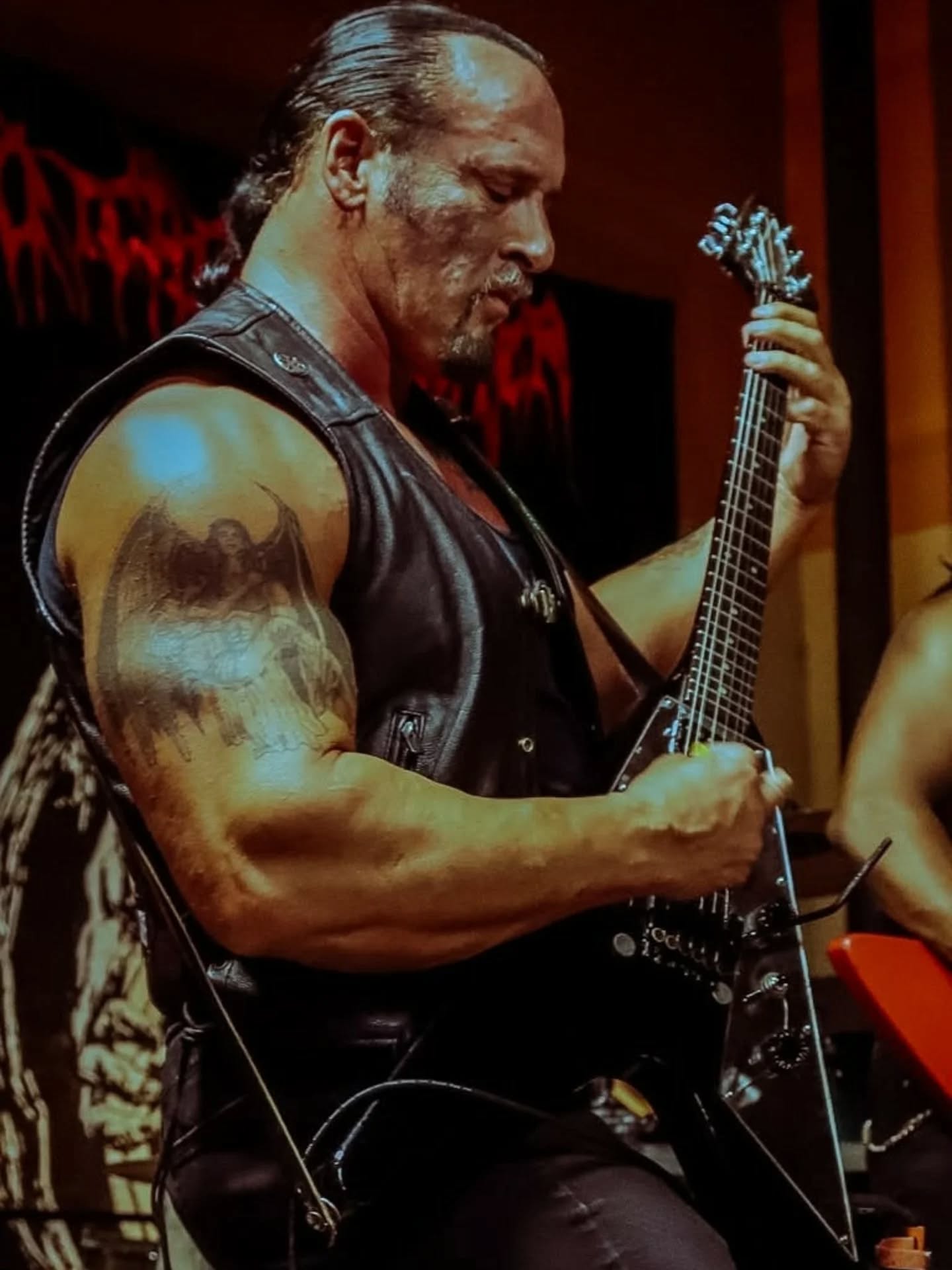
Marco Banco is a name deeply connected to the foundations of Canadian extreme metal. Emerging from the Vancouver underground in the mid-’80s as the guitarist and founding force behind Witches Hammer, Banco was part of a generation that created extreme music before the internet, algorithms and global attention changed the underground landscape.
From the raw Speed Metal attack of Witches Hammer to his involvement with Blasphemy during the creation of the legendary ‘Fallen Angel of Doom….’, Banco witnessed and contributed to one of the most important chapters in the history of Canadian extreme metal. His journey continued through Tyrants Blood and the return of Witches Hammer, proving that his dedication to extreme music has never been tied to trends or outside recognition.
Beyond music, Marco has also maintained a disciplined lifestyle focused on fitness, training and personal health, showing the same commitment and consistency that has defined his musical career. After more than four decades involved in the underground, Marco Banco remains a true survivor of an era built on passion, dedication and doing things without compromise.
You have been part of the Canadian underground since the early days with Witches Hammer. Looking back to the mid-’80s, what was the Vancouver scene like before extreme metal had any worldwide recognition?
There really wasn’t a scene for anything extreme like speed or Thrash Metal, etc. because it didn’t actually exist. There was a Heavy Metal scene here in Vancouver, but it was comprised of very few bands, and they were quite separated from one another. In the high school I went to, music, hard rock, rock ‘n’ roll and heavy music were really popular. In fact, being a musician was what all the cool kids did. Without thinking about it too much, I think the need to create something of our own came naturally. So of course we did our best to steal their Nazareth and Led Zeppelin cool and create something completely different.
Around 1983 I wanted to create a metal band based around our ’70s street gang style, ‘The Warriors’. That ended up being the goal, which was fantastic because the old guard absolutely hated everything we did. Their day was done, and I suppose seeing the inevitability of that caused them great strife. I’d also say what was different was that everything was in front of us in those days, rather than everything being behind us as it is today with extreme music. With today’s music, a lot of groups emphasise trying to bring back something that has already existed, or looking to emulate or sound like something before them in order to become relevant. Of course that wasn’t something that would have existed back in those days because there wasn’t anybody really to copy directly in a way that could be acceptable.
As far as extreme music went, you just kind of listened to what you liked and created your own style from that, because it would’ve been absolutely ridiculous to sound exactly like one of the upcoming groups like Slayer, Metallica, Bathory, Sodom, Celtic Frost or Venom. If you did sound too much like one of them, it’d be an utter failure because there weren’t enough bands around for your group to be so lazy as to just rip off someone else’s sound. That would’ve been just bloody ridiculous.
Witches Hammer was formed in 1984 when you were still very young. What pushed you towards creating such aggressive and dark music at that time?
I really enjoyed all kinds of music. But when I started to play guitar, I found that I really liked playing heavy music. Motörhead, Judas Priest, Black Sabbath, Scorpions, Iron Maiden… all that stuff was really attractive to me when it came to playing the instrument, so that’s how it evolved.
Then of course when Venom’s ‘Welcome to Hell’, Exciter’s ‘Heavy Metal Maniac’ and Anvil’s ‘Metal on Metal’ showed up, that was that.
The early Witches Hammer demos have achieved legendary status among underground collectors. Did you ever imagine those recordings would still be talked about decades later?
Not at all. Everything was very localised. A bunch of feral kids in school don’t see much further than the school year or what’s happening that weekend. When I was 15, 20 seemed old and may as well have been on Mars.
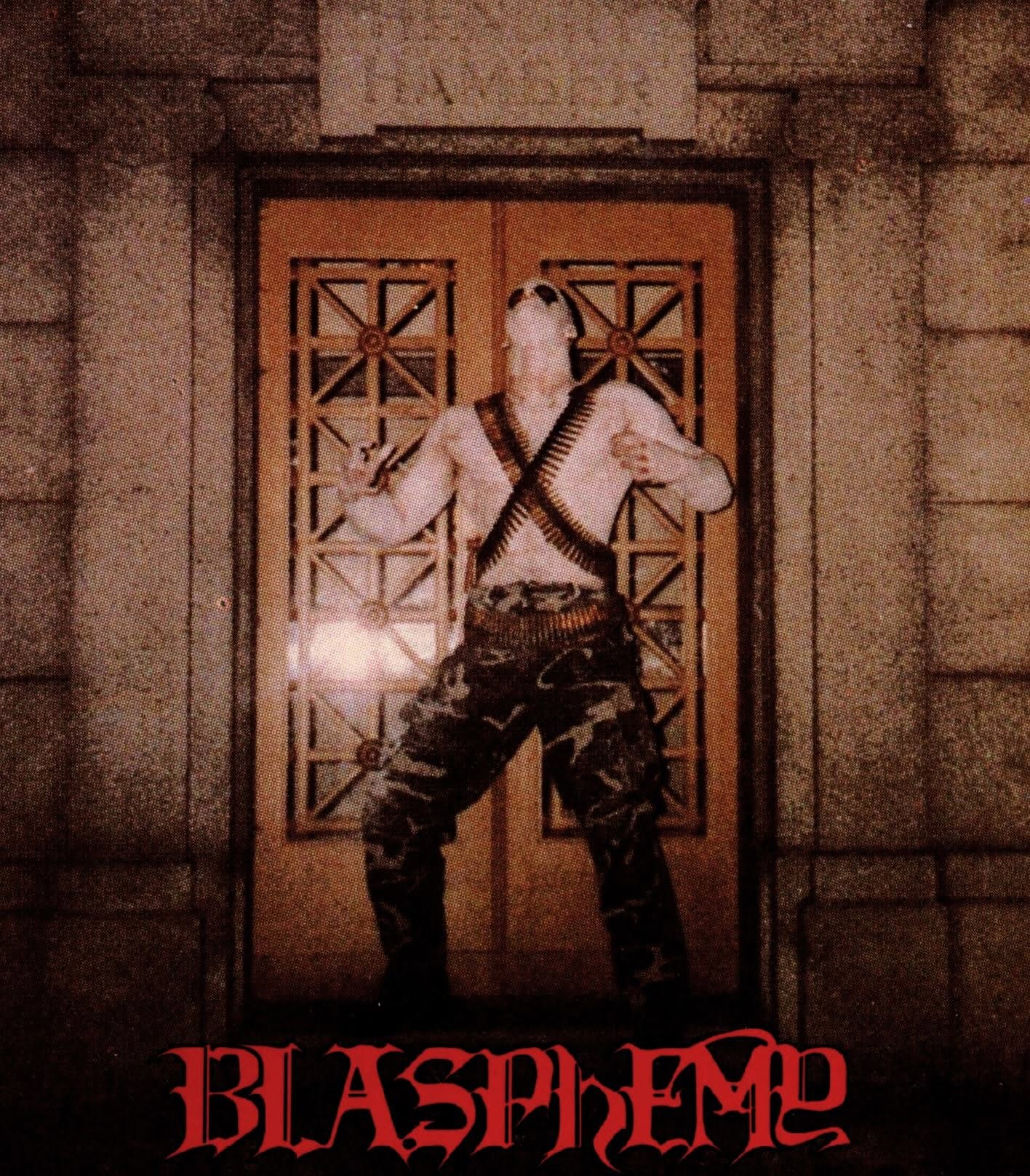
How did you become involved with Blasphemy, and what are your strongest memories from the period leading up to the recording of ‘Fallen Angel of Doom….’?I’d known the guys, especially Gerry and Jeff, for quite a few years because of going to local shows and seeing them there since about 1984 or 1985. Of course those guys knew that I’d been playing guitar for quite a while, and so when Black Priest had left Blasphemy, it just so happened that a week before that Witches Hammer had called it a day and we folded it up.
I was actually asked first to join a local band called Death Sentence, and then the next day Gerry called and asked me to join Blasphemy. I thought about it for a couple of hours and chose Blasphemy over Death Sentence. They were the right choice, and of course I really liked that group a lot. I thought that what Blasphemy were doing was really cool, and so of course I wanted a piece of that. I saw them as being a very original act and something that nobody was doing before. That was very appealing to me.
I think my best memories, though there are many, would be the early era of this speed/Thrash Metal movement. Because it was our thing. It was dwelling in the shadows, in the East End, in the most underground clubs. What made it cool was that it was so hated by traditional hard rock and Heavy Metal people. To me that was the best because you knew that you were at the beginning of something.
So with that chaos and upheaval, joining Blasphemy in 1989 just continued in that same realm of absolute madness. When you’re young, strong and breathing that kind of fire, it’s all welcome, and I absolutely loved that lifestyle.
Being part of that era placed you right in the middle of an important chapter in extreme metal history. Looking back now, what do people misunderstand about the Vancouver underground and the Ross Bay era?
I’m not really sure what they misunderstand. Perhaps, and I’m not sure if this is a misunderstanding or even something that most people don’t know. I would assume that most people do. But that would be as I described before: at that time everything was new and the sound was evolving. You had different artists and bands, everybody sounding different and creating their own stamp. The complexion then was that everything was in front of everybody involved. There was nothing behind it, so it was all creation, inventiveness and originality. Even the groups that were gaining popularity, Slayer, Metallica, Dark Angel and Possessed, were only in their early twenties at the time, and us being fans and listeners were just young teenagers. So the template was being built rather than copied. I’m not sure if that’s a misunderstanding. I think most people these days, since the style of music has been around for about 45 years, realise this fact.
After leaving Blasphemy, you continued your musical journey through different projects including Tyrants Blood. What kept you motivated to remain active and creative through all these years?
MB: After I left Blasphemy, I stayed out of the music industry for quite a while. I didn’t get back into playing heavy music again until 2004 or 2005, so I was really out of the music business for about 13 years. I just wasn’t a fan of anything coming out in the ’90s. I found it rather pedestrian and boring. The early ’90s were fantastic with what Morbid Angel, Deicide, Death, the Florida Death Metal scene and the Swedish Death Metal scene were producing. I thought that was cool as Hell. But by about 1993 or 1994 I was completely bored with everything that was coming out, so I basically dropped out of it.
Tyrants Blood brought together musicians with deep roots in Canadian extreme metal. How did the band come together, and what was the chemistry like between the members?
Quite by chance actually. I really didn’t want to get back involved in playing in a band anymore. I was very busy and quite content doing what I was doing. But an ex-girlfriend of mine and the original drummer, Kevin, had been bothering me to come out and jam for almost three years. I really had no interest until one day I had a day off and was looking for something to do. Kevin happened to call me to come out and jam if I wanted to, so I put my old amplifier and guitars in the back of my truck and drove out there on a Sunday morning.
As a matter of fact, it was pretty ominous and foretold that what was going to happen was going to be quite interesting. There had been a fire about three blocks away from Kevin’s place. It completely blocked out the sun and the sky, and I couldn’t see a damn thing in front of me. I was driving very slowly through the smoke and what was cool about it was that the fire in this old building had displaced hundreds and hundreds of crows. Through the smoke all the displaced, crazed winged rats were flying around, landing on the car, going past the windows, screaming bloody murder. Pretty fucking cool, and a great way to start that band in my opinion.
The chemistry in that band was to create a band that brought Vancouver out of its mundane doldrums and the ridiculous comedy metal scene that it had become, where every band seemed to be taking the piss and writing joke songs. So we did just that. No gimmicks, just straight metal.
Witches Hammer eventually returned after many years. What made you decide the time was right to resurrect the band, and how different is your approach to songwriting today compared to the ’80s?
In 2017 I was having a conversation with Ray (vocals) and Yosuke (NWN), and Yosuke randomly asked how much material we had never recorded back in the day.
I said, “We have lots of basement demos, riffs, all kinds of jam sessions we recorded that never saw a proper studio.”
He said, “Do you want to record them?”
I was against it, and so was Ray.
But then we started talking about our original drummer John and how many songs he wrote with me. Maybe it would be cool to give his legacy a proper epitaph, especially since he was one of the guys who literally started and created the extreme metal scene here in Vancouver, BC.
I thought about it for a couple of weeks, knowing that digging up all those old demos was going to be a huge task.
After I got my head around it, I called the guys and said, “OK, I’ll start putting everything together“.
It took me an entire year to find everything. I relearned a ton of riffs from those 1984-88 tapes, brought them to the studio and off we went.
The songwriting therefore is exactly the same, since most of the songs and the riffs were already written in the 1980s.
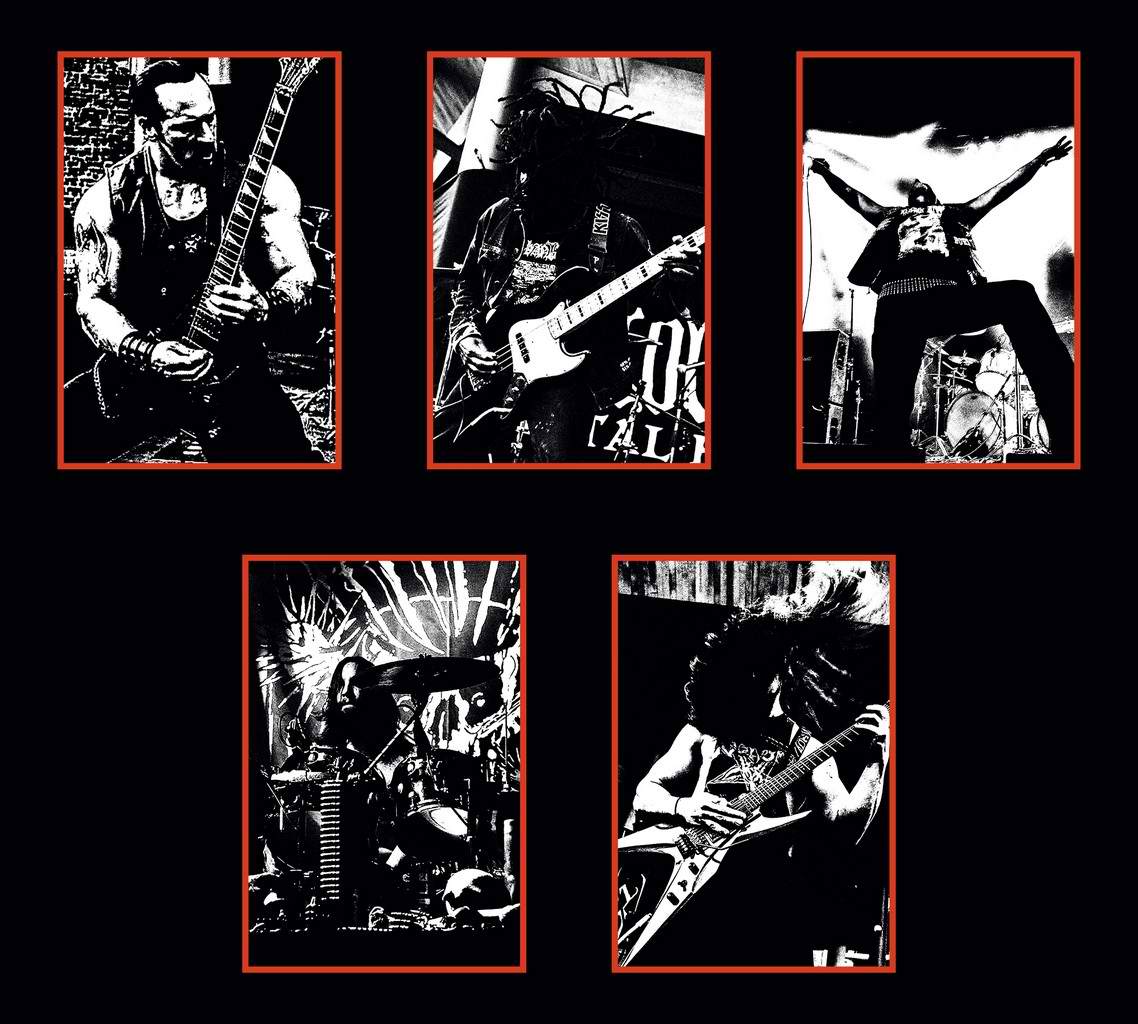
The latest Witches Hammer material has continued the band’s legacy and has seen renewed interest from collectors and fans of old school metal. Can you tell us about the current release plans, the latest album pressing and what fans can expect from this new chapter of Witches Hammer?
‘Final Storm’ will once again be released by Nuclear War Now! Productions. Mid to late July is the release date. It will be available on all formats: vinyl, cassette and CD. This album continues in the same style as always. It contains a lot of unreleased riffs and music written in the 1980s, finally given their breath. Fast, raw Heavy Metal.
Outside of music, you have maintained a very disciplined fitness lifestyle for many years. How important has training, consistency and taking care of yourself been throughout your life?
Training, sports and fitness have been an integral part of my life and daily routine since I was about five years old. That lifestyle has always remained. I wouldn’t know, until I’m unable to, what life would be like without it.
A lot of younger people today struggle with unhealthy routines and the convenience of processed fast food. What advice would you give to the younger generation about building discipline, improving their lifestyle and taking control of their health?
This prolonged coddling of children, well into their more independent years, has really caused a lot of unhealthy young people. Personally, more of the advice should obviously go towards the parents who aren’t creating enough rigid structure for their children by letting them eat whatever they want, whenever they want. The abundance of food and the prosperity we have achieved, even though it is far better than going hungry, is causing a lot of strain on the medical system. We all know that obesity is a huge problem in society. Seeking out positive role models, finding a coach, a trainer, a mentor or a peer group that involves itself in healthier lifestyles is obviously the key. Easier said than done, surely, but absolutely necessary if you want to create positive change. You need to remove yourself from all your external influences and those bad habitual factors. Fix one small thing at a time. Use the Kaizen principle. Every day, try just a little more. Add an extra minute to your cardio, add an extra minute to your studies. No matter what, create even the smallest success every day to begin building a chain of accomplishments.
You have remained active for over four decades. What keeps your passion alive for music, training and personal growth?
All three of these points are necessary. Simple as that. Art, health and education.
The underground has changed drastically with streaming, social media and digital platforms. Do you think modern technology has helped or damaged the spirit of underground metal?
Technology has definitely made everything more viable. The “underground” is now a popular place. I’m from a completely different generation. None of it existed. I enjoyed that because it was hidden in the shadows, in the sleazy East End clubs. This is a much safer, more sterile environment. Everything is for everyone. So I think it’s more difficult for artists to truly stand out amongst something so saturated. For better or for worse, however you look at it, the skill sets these days, due to technology, are fascinating. Whether you believe originality has died or not, someone will always rise up and make their mark. It’s inevitable.
After everything from Witches Hammer, Blasphemy, Tyrants Blood and beyond, what moments stand out as the defining chapters of your journey?
My first jam session with Witches Hammer in 1983. My first ever live experience, opening for Exciter, Exodus, Metal Church and Sacred Blade in 1985. Performing outdoors next to the Amazon River and jungle in Brazil. Those are three major standouts for me.
Finally, what message would you like to share with the younger generation discovering Extreme Metal today?
I suppose… embrace the cold and headlong into havoc. Like wolves in winter. Get out of your comfort and warmth. This lifestyle and its music are best written through hunger, deprivation and extreme thirst.
Thank you Marco for your time on behalf of VM-Underground and its readers.
Thanks for the time.