From one of Asia’s most dynamic cities comes Rudra, a quartet who are solely responsible for opening a new frontier in Extreme Metal. For more than a decade now they’ve combined their fascination with Vedic philosophy and the most abrasive Death Metal, creating such stunning albums as this year’s epic ‘Brahmavidya: Transcendental I’, the latest in a planned trilogy that would put most bands’ oeuvres to shame. Not sparing words about his band’s intentions, frontman and bassist Kathir talks to VM about the new record, his Heavy Metal influences, and Kama Sutra.
Hello Rudra, how are things going down in Singapore? Here in the Philippines it’s raining every day.
Things are good here except for the scorching heat of late and the swine flu scare!
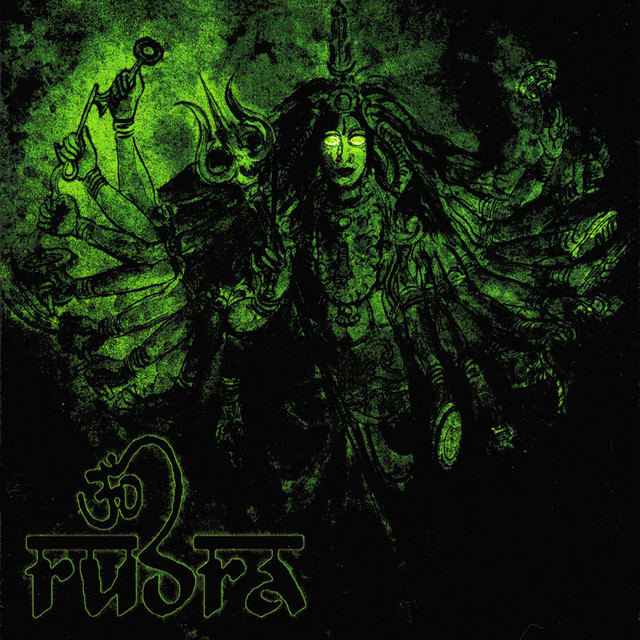
So are you stoked about the reactions you’ve been getting for your newest, ‘Transcendental I’, so far? Since your discography is already (what?) six albums deep, what kind of work ethic does the band bring to the studio?
Of course, in many ways this album is different. It’s the first album with Devan, our new guitarist. And it is also the longest album ever produced by us, clocking almost 67 minutes. And moreover we were under pressure to produce an album that lived up to its predecessor, especially for the fact that it’s the second chapter of a trilogy.
We do try to churn out at least an album every two years. But sometimes we get too busy with our personal life and work at the office which may throw our plans off track. Nevertheless, when we enter the studio to write an album, it takes almost a year because we meet once a week for about three hours to write a song. Most of the stuff is written in the studio together as a band. This may appear unusual to a lot of foreign bands but this is how we work. We spend a lot of time away from one another and neither do we hang out much. Partly it is something we are unable to avoid due to our personal commitments outside the band. So it does slow things down but we are happy that we have released five albums in about 11 years since our first full-length album.
Your previous album ‘Brahmavidya: Primordial I’ came out last year and it’s just as potent as your newest. At this stage, is a new record already slated for 2010?
‘Brahmavidya: Primordial I’ was originally released in 2005 but it got re-released by Trinity Records Hong Kong last year. However, we have already started writing the new album and almost five songs have been written. We hope to focus on the next album which will also be the final chapter of the Brahmavidya Trilogy. We would like to cut down on the shows and concentrate on the next one and then tour and play shows for the next two years. We intend to enter the studio in November to start laying down the tracks.
How did Rudra join Trinity Records’ roster?
We have been looking for a new home since we departed from the last record label. And we also wanted a label closer to our shores so that they would understand the trials and goals of Asian bands stuck in this part of the world. Then came Trinity Records, which has always been one of the more popular record labels in Asia and its owner Soni is a passionate guy too. So it just clicked when we started corresponding with each other.
In past interviews you’ve confessed to preferring more intimate, but less frequent shows as opposed to constant touring. How many performances are lined up for your new album? Will Rudra be pushing for a USA tour even if the last attempt didn’t succeed?
In fact we just did a show here in Singapore last week and have one more slated for Hong Kong next month. After that we would like to get back to the studio to finish up the next album before we dedicate ourselves to more shows till 2012. I believe many didn’t know that we did a 2007 mini-US tour covering three states in the US.
You’ve already explained in countless interviews before that Rudra represents the Hindu god of death, Shiva. But for the umpteenth time, can you elaborate on the philosophical texts that your music is based on? Just how huge is Vedic literature?
Vedic literature is too voluminous, having thousands of texts. We are very inspired by the Vedic philosophy called Advaita, which means non-dualism. It is an ancient philosophy that aims to establish the supremacy and primacy of the Self. In the vision of Advaita there is no God but myself. In fact the concept of God is reduced to a mass of consciousness pervading the whole universe. Hence, from one standpoint I am the whole universe or the universe can be seen as never separate from me. This has been the lyrical theme of Rudra since the first album.
Forgive me, I’m a hopeless romantic, but what insight does Vedic literature give on the love between a man and a woman and the role of sex in particular?
You should check out the Kama Sutra, the oldest Vedic text on sex, hahahahaha! As per the Vedic literature, sex is for the perpetuation of the human race and also for pleasure. In fact, to enjoy sex, you don’t have to be in love with the other person. It can be an act by itself without having an emotional relationship with one’s partner.
Can you go back to your days in compulsory military service? Wasn’t this the time you began dipping into philosophy? Besides the soul-searching and intellectual awakening, what were you trained in?
Yeah man! That was about 17 years ago. I was dabbling with the occult, philosophy, and religious studies. I was serving in the Army then. I was trained in Armed Forces Administration so I had a lot of time to read and explore unlike others busily fighting imaginary enemies. This was when I fused my philosophical and spiritual interests into metal.
When you started exploring Hindu/Vedic philosophy, where did you go to find the right books? How much of it did you encounter while you were still studying?
I studied Vedic Philosophy in high school as part of the Cambridge curriculum. So I can say that I had a sort of initiation in my teenage years, which I resumed later in my late teens. From thereon I grabbed books from bookstores that attracted me. But most of my deep Advaita studies came from my direct discipleship with a monk ordained by the ancient Advaita tradition. My tutelage with him lasted almost five years.
I’m guessing you have a sizable library at home to nourish your intellectual pursuits? Between your day job and music, when do you find the time to read?
Yes. I have over 1,000 books for reference in my personal library spanning diverse subjects. I mostly study at night and spend most of my free time reading.
Isn’t one of the band deeply into the occult and Satanism? What other interesting hobbies do the rest of Rudra have?
None of us is into any satanic crap. To accept Satan you have to accept the opposite of Satan, which is a creator God. We reject them both. The belief in Satan is similar to the belief in God. To me they are both beliefs that are not of any value to one who is not interested in getting into another belief system. The other guys in the band spend most of their time with their wives and children. Devan loves photography. But all of us love music.
Now at what point did your reading (in Vedic literature) intersect with the desire to play Death Metal?
Probably in 1993 when I entered National Service. A book I stumbled upon triggered the idea. By then Rudra, at that time spelled as Rudhra, was already formed.
What was your introduction to metal in general? I believe you’ve been a metalhead since the late 80’s/early 90’s? What was the metal community in Singapore like then? Where did metalheads congregate and buy their music?
My introduction to metal was King Diamond. Before that I was listening to heavy metal and hard rock bands like Mötley Crüe, Guns N Roses, Def Leppard, etc. Eventually it grew on me and I started discovering Slayer, Megadeth, Bathory, Death, Kreator, Helloween, Sepultura, Black Sabbath, and many other bands. During those days the metal community was big and we hung out at a place called Plaza Singapura. It was always a Saturday night affair where we hung out and exchanged tapes and chatted about our favourite bands. Most of the tapes were bought from two or three CD and tape stores that carried underground stuff.
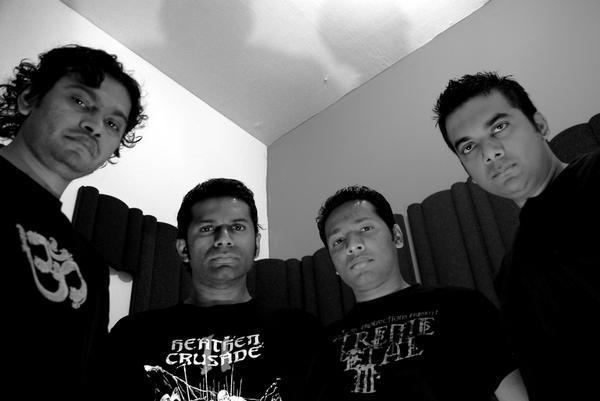
You know what? I’ll gladly name all your metal influences: Slayer, Death, Kreator, Megadeth, Morbid Angel, Cynic, etc., etc. Can you do us all a favour and discuss your other influences from across the musical spectrum? I’m referring to the Hindu artists you admire but are unknown to most metalheads. Perhaps A.R. Rahman is one of them? I really don’t know.
I would not call the other influences Hindu but they are diversely ethnic which includes Ravi Shankar, Nusrat Fateh Ali Khan, A.R. Rahman, M.S. Visvanathan, Jai Uttal, Krishna Das, and Dr. L. Subramaniam.
You only play the bass? What was your musical education like? Did you spend countless hours and sleepless nights practising? Are you satisfied with the growl you have at the moment? It sounds pretty wicked, in my opinion.
Although I can play the guitar and drums, my principal instrument is the bass. I am self-taught. Yes, I did spend countless hours and sleepless nights mastering the bass. With regards to my vocals, I am pretty satisfied. Over the years I have learned to be consistent with my vocals. Thanks to Joshua Nair who has helped a lot with improving my vocal performance during recording sessions.
What tore the original Rudhra apart? Sorry, but I’m not that familiar with your complete discography but had you released an album by the time ‘Rudhra’ broke up? What do you think has kept Rudra going strong until today?
With Rudhra we recorded a few songs and also released a demo. Unfortunately, the band fell apart due to musical differences. I wasn’t too keen on playing technical or melodic Death Metal. I liked riffs that were more soulful and at the same time hard hitting. I had violent disagreements with the band, which wanted to be a guitarists’ band at that point in time. On the other hand, I was the total opposite who wanted to focus on writing songs as a band instead of focusing too much on the guitars. That led to the hiatus, which eventually gave birth to Rudra again, but with an altered spelling. We have never looked back ever since and I guess we have kept the fires burning because we love both the subject that we write about and extreme metal.
Can you recount the details behind the Rudra shows in Malaysia and India? Who were the promoters who brought you there? How many new friends did you make in your travels? Were people blown away by your unique sound?
There were a couple of promoters and University departments that invited us in the past to India. I can’t remember the names of the Malaysian promoters though. We made lots of friends in the course of our tours and we have always kept in touch with them. The crowds abroad have always been fascinated with our music. It’s always nice to play to an appreciative audience. In fact the US tour was awesome! The Americans were so receptive to our music.
Since the four of you are Tamils born and raised in Singapore, have you been watching events in Sri Lanka these last few months?
Not really. Actually the ancient homeland of the Tamils is Tamil Nadu in India and not Sri Lanka. Three of us are Tamils. Devan is a Malayalee who traces his descent from Kerala, India. Having said that, I would not consider India my homeland. My homeland is Singapore because this is where I was born and raised. However, we call ourselves people of Indian origin with profound respect for India’s rich literary and philosophical traditions.
Do you know the Singapore band Nafrat? They’re pretty cool. I have their last album ‘Through Imminent Visions’. Ferocious stuff.
We had a chance to share the stage with them just two weeks ago. In my opinion, Nafrat rules!
Unfortunately this interview has to end. I still have so many questions to ask but time and length constraints prevent me from doing so. But one last question: Dragonforce, Megadeth, Heaven and Hell… since so many ‘big’ metal bands visit Singapore, do you make it a point to see them?
Of course, but not Dragonforce as I’m not a fan of such music. But I did catch Megadeth and Heaven and Hell. Thanks for the interesting questions! Hoping to play a show in the Philippines, the land of fine musicians, soon.
