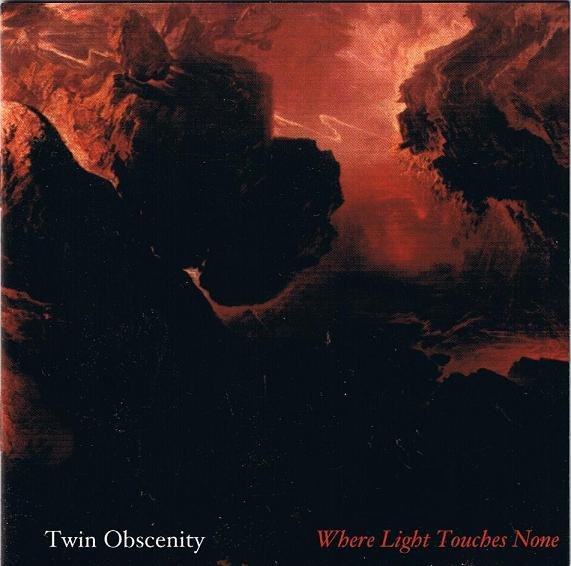
Twin Obscenity were one of those Norwegian bands that could easily get overlooked when people talk about the explosion of Extreme Metal coming out of Norway during the 1990s. Formed in Stavanger in 1991, the band had already gone through several demo recordings before finally releasing ‘Where Light Touches None’ in 1997 through the Norwegian label Head Not Found. By then, the lineup had settled around Atle Wiig on vocals, guitars, and keyboards, Jo-Arild Tønnessen on bass, and Knut Næsje on drums, with Tonje Ettesvold providing female vocals.
What makes ‘Where Light Touches None’ interesting is that Twin Obscenity were not simply following the colder and more straightforward side of Norwegian Black Metal. There is definitely a Black Metal foundation here, but they brought in a much more melodic and atmospheric character, with keyboards and female vocals adding another dimension to the arrangements. The songs can move from rougher guitar passages into grander and more melodic sections without completely losing their darker character. There is also a strong sense of old Scandinavian metal running through the songwriting, which gives the album a personality separate from the more obvious Norwegian names of the period.
The album was recorded and mixed at Sound Suite Studios between September 9 and 22, 1996, with Atle Wiig producing and Terje Refsnes handling the engineering and mixing. The original album runs for around 38 minutes, which is a good length for this kind of material because the songs have enough space to develop without the record becoming unnecessarily long.
I first came across Twin Obscenity through ‘The Usurper’s Throne’, which later appeared on Osmose Productions’ ‘The World Domination II’. That was exactly the kind of compilation discovery that made the 1990s so interesting for me. You could buy a label sampler, hear one unfamiliar band, and suddenly realize there was an entire album sitting somewhere behind that one song. Twin Obscenity were one of those names that made me want to hear more because ‘The Usurper’s Throne’ had enough character to stand out among a compilation packed with much bigger names.
Going back to ‘Where Light Touches None’, you can hear where that individuality came from. The guitars have the necessary bite, but the keyboards are crucial to the overall identity rather than simply being placed in the background for decoration. Tonje Ettesvold’s vocals also give the record a distinct atmosphere, particularly when they are contrasted with Atle Wiig’s harsher delivery. The combination creates something more expansive than straightforward Black Metal, while the underlying riffing keeps the music firmly rooted in Extreme Metal.
There is a certain old-world feeling throughout the album as well, which fits the band’s fascination with Norse mythology and their generally medieval atmosphere. The music has an adventurous quality without becoming overly polished or losing the roughness that made so many 1990s releases memorable. You can hear the band reaching beyond the basic Black Metal template and trying to build songs with more color and movement.
Looking back now, ‘Where Light Touches None’ is also a useful reminder of how much variety existed within the Norwegian underground during that period. When people talk about 1990s Norwegian Black Metal, it is easy to reduce the whole scene to a handful of famous bands, but there were plenty of groups developing their own interpretations of the style. Twin Obscenity belong to that less-discussed side of the story, and their debut has enough individuality to make it worth revisiting.
For me, the connection to ‘The World Domination II’ makes the album even more interesting. Hearing ‘The Usurper’s Throne’ on that Osmose compilation was the introduction, but the debut is where the complete picture comes together. ‘Where Light Touches None’ shows a band willing to mix Black Metal with melody, atmosphere, keyboards, and contrasting vocals while still keeping the music firmly connected to the darker Scandinavian underground. It is exactly the kind of record that reminds me why those old label compilations were so important in the first place: one unfamiliar song could open the door to an entire album that you might otherwise never have found.