When a weary soul retreats into the chambers of the mind, it searches for the embrace of repose. At times, tranquility becomes the line that we wish not to cross, for why should one abandon its dwelling of peace to search for that which lies beyond, within the void? For once our feet touch beyond the border, the soul that follows undergoes a transformation in its countenance, for that which was may never return. Into the unknown we venture, and sojourners we become. The truth that lies concealed within the abyss may reveal itself as an offering, and thus the journey begins, the quest through which we ask ourselves whether the sacrifice required to attain such knowledge is worth it.
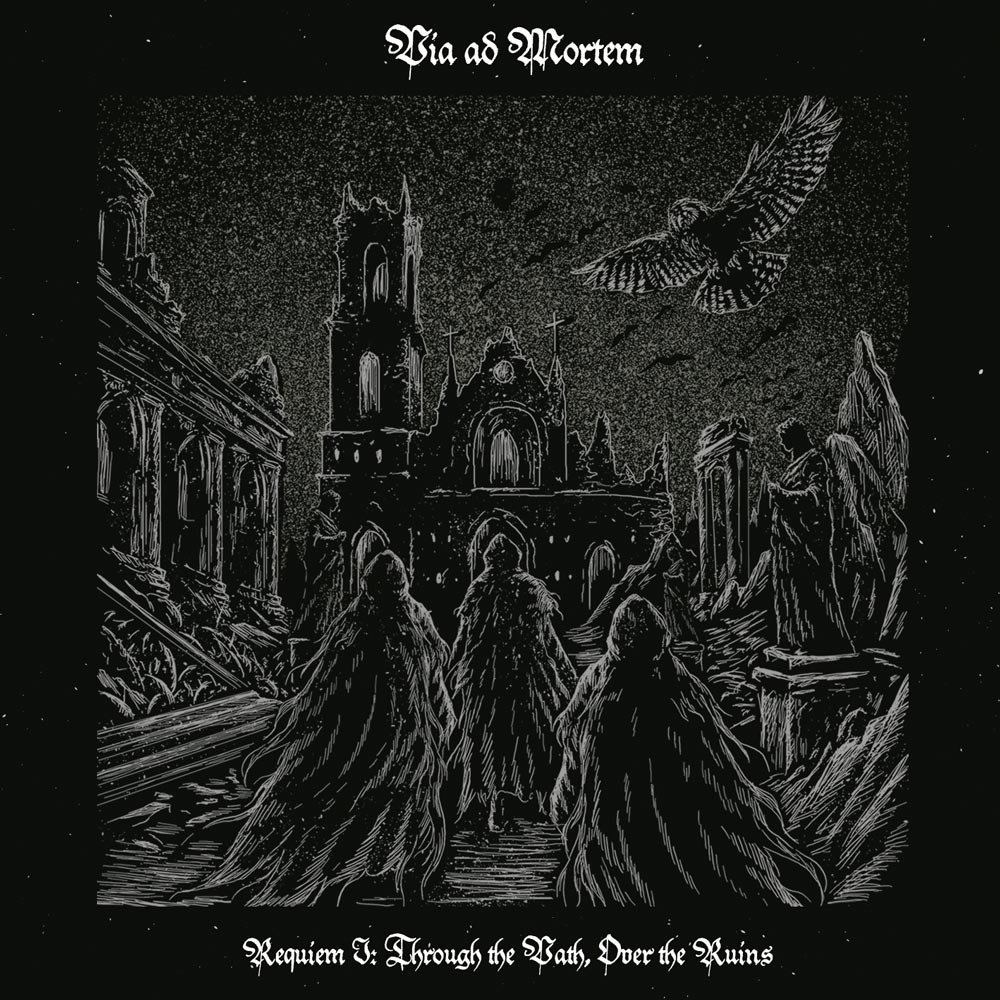
‘Requiem I: Through the Path, over the Ruins’ by Via ad Mortem is the truth hidden amidst the Stygian planes, the gnosis of that which is discovered only through the deconstruction of one’s consciousness, for unto its hymns, the soul gives in order to receive. Resonating in a transcendental form of Black Metal, similar to bands such as Cult of Fire and Mephorash, Via ad Mortem places ritual at the focal point, creating a dialogue between mind and art through sound. Communion is fostered through the transmission of Via ad Mortem, as the soul relinquishes control, slowly stripping away from itself the frivolities that matter not. In turn, it gains an essence unbridled in its force, neutral in its power, yet hierophantic in its delivery.
The album undergoes an unorthodox movement through the resonance of its guitars, for even though their tone speaks in a tongue of aggression, their demeanor appears in a natural state, meaning their harsh essence of sound feels neither hostile nor malevolent. Rather, it employs more of an esoteric feeling, like a choir of chants that swirl and rise in unison, each mouth uttering an invocation discernible only to itself, but with the hymns converging into a unanimous vessel.
‘Muchita – Night in Lima’ and ‘Worshipper of Death’ are tracks that carry a similar cadence, where the guitars become the infrastructure of the atmosphere, fluid in motion, yet also caustic, with the production rendering them in a scathing temperament, thin and serrated. However, possessing a raw tone does not merely translate into a bewitching experience. This is where Via ad Mortem showcases their craft, taking these textures to construct the very entity with which the soul wishes to commune, where each melody that cascades like waves becomes the energy that flows from the art into the mind, connecting like tendrils as the senses slowly merge into the very notes.’Into Bardo’ is a testament to this, where its intro shifts its stance into a more slow-paced riff, then morphs into a frenetic variation while still retaining its harmonious spirit.
Whenever the air rings with the chanting of devotees, there exists the punctuation of drums and the crashing of tingsha bells, as though the reverberations carry the voices into the realm they wish to traverse. Via ad Mortem takes a similar approach, where the percussion becomes the other half of this orison woven through the strings’ dialogue. In turn, every beat transforms its state to complement the riffs, both acting as an anchor and lending gravitas to the soundscape.
The production also acts in tandem with the percussion, draping it in a subtle yet blunt sound. The track ‘Over the Ruins’ demonstrates this, where the drumming acts in rhythm with the guitars’ meandering, slow-paced patterns, with every beat timed in a pulsating manner, hypnotic in a sense, but also acting as a focal point through which the guitars are amplified. However, a trait that exists within the track, as well as throughout the whole album, is the symbiosis between the drums and guitars, where the percussion merges with the guitars’ upward energy, both riding in unison. The beats and riffs shadow each other until they climax and then plateau.Each burst of the drumming can be likened to a triumphant declaration, where exultation is found through the recitation of one’s own litany.
When a soul embarks beyond the borders of its internal world, stepping onto the soil where we know not whether our questions will be answered with more questions, we may instead seek out a beacon, something to guide us, to help us traverse these unknown lands. For it is like one who follows the river’s path, its winding features, in hopes of making it out of the forest.
In a similar manner, the essence of the vocals acts as both the compass and the teacher, where the soul follows but also heeds. A raspy, archaic energy is manifested, its physical cadence feeling dried and serrated, as though the vocal patterns have weathered both time and the tongues that have uttered their verses. The production, by extension, adds a ritualistic air to them, where the vocals almost appear like an apparition, their features gliding and dissolving into the guitars and drums, as heard on ‘Rib for a Rib.’
In hindsight, the vocals do align with what one would consider stereotypical Black Metal vocals, for the attributes are all present. But I would challenge this by adding that it is not the register in which the album is sung that makes this work of art unique, but rather the shaping of it, where the vocals feel intimate and fluid in their motion. ‘The Grace of Gnosis’ showcases this, where the inflection of each enunciation derives a confrontational sensation, as though you can hear the spit being strewn from the mouth, the vocal cords being exerted, as well as the teeth baring themselves in a snarl as each word is uttered in reverence.
The gospel of Via ad Mortem removes the scales from one’s own vision, and the flesh is now perceived as a husk, fragile and decadent. Its melodies entrance the mind, beckoning it to become recumbent amongst the fires, to be cleansed and to leave that which is physical behind as the spirit communes with the void. For what is gleaned becomes knowledge beyond the discernment of the flesh, yet stone to the tongue.