
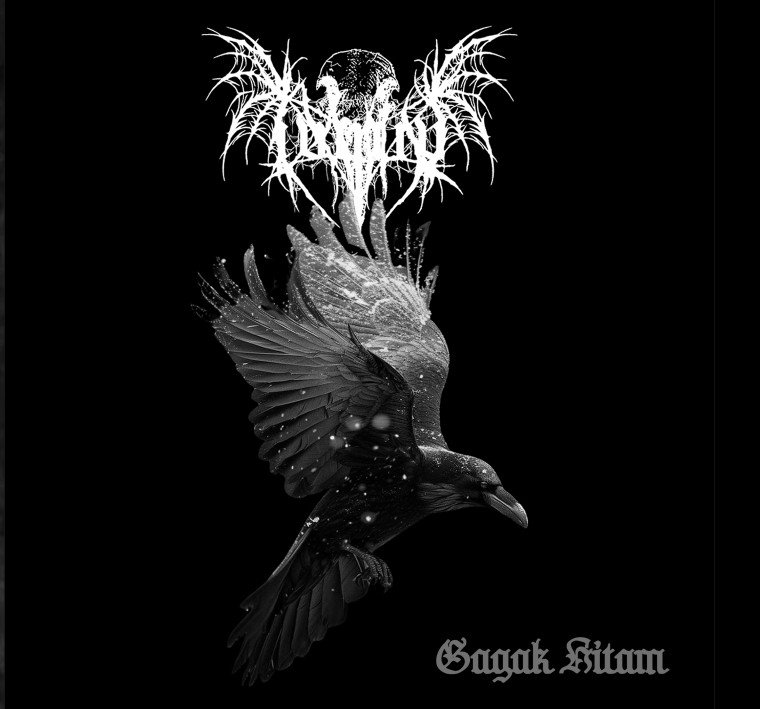
There is something about digging into Malaysian Black Metal that keeps throwing up bands who have been quietly building their own little worlds while everybody else is busy chasing whatever the latest European trend happens to be. IV V I IV from Pahang are one of them, and ‘Gagak Hitam’, their third full-length, is the kind of record that rewards sitting down with the whole damn thing rather than cherry-picking a track and moving on.
Six songs, fifty minutes and very little interest in rushing anywhere. The band describe themselves simply as Raw & Atmospheric Black Metal, but that label only tells part of the story because ‘Gagak Hitam’ is far more melodic and expansive than the word “raw” might suggest. The guitars carry most of the weight, moving between cold tremolo passages, heavier riffing and melodies that occasionally become surprisingly beautiful without turning the whole thing into some soft-focus post-Black Metal exercise.
‘Gurindam Bala’ immediately sets the standard. The guitars come tearing in over rapid percussion, but there is plenty of breathing space between the attacks, allowing the melodies to develop instead of simply stacking tremolo riffs on top of blast beats. The vocals are used sparingly, which actually works in the band’s favour because the instrumental sections become part of the storytelling rather than feeling like empty space waiting for somebody to start screaming.
‘Rembulan Di Ufuk Sengsara’ slows things down and brings a heavier, almost traditional Heavy Metal quality into the riffing. There are synth melodies tucked into the arrangement as well, giving the song a strange contrast between cold guitar work and something much more fragile. This is one of those moments where IV V I IV show that they aren’t interested in keeping every song trapped inside the same tempo or emotional register.
Then comes ‘Tabir Durjana’, and this is where the album really starts biting. The riffs are more direct, the pace changes more frequently and the vocals eventually push the whole thing into a more aggressive gear. It is probably the strongest example of how much can be squeezed out of this band’s relatively stripped-down approach. Nothing sounds overcrowded, yet there is always something moving underneath the main riff.
The problem comes around the fourth and fifth tracks, where some of that momentum begins to disappear. ‘Derai Nafas Akhir Menghela’ is not a bad song at all, but its slower, more post-Black Metal character makes the album feel slightly heavier going after the intensity of the first three tracks. ‘Gemuruh Gagak Hitam’ has plenty of atmosphere and solid guitar work, although it suffers a little from arriving at that point in the record where the listener is already waiting for something to shake things up.
Fortunately, ‘Fana’ closes the album on a much stronger note. It brings together the melancholy, aggression and melodic side of IV V I IV without sounding like a desperate attempt to make the final track into some grand finale. The guitars have room to stretch out, the atmosphere becomes more dramatic and the whole thing finally feels like it has reached somewhere rather than simply stopped.
What I appreciate most about ‘Gagak Hitam’ is that IV V I IV aren’t afraid to let their songs breathe. There are no cheap tricks here, no endless blast-beat worship and no need to cover every available second with noise. They understand that a good melody can carry as much weight as another fifty riffs thrown into the mix.
This isn’t going to appeal to somebody looking for nonstop primitive violence, and that’s perfectly fine. ‘Gagak Hitam’ is more patient than that, sometimes even to its own disadvantage, but when IV V I IV hit the right balance between cold aggression and melody, they produce something that feels distinctly their own.
For a Malaysian Black Metal band already three albums deep, there is enough character here to make ‘Gagak Hitam’ worth hunting down. ‘Tabir Durjana’ and ‘Fana’ are the killers for me, but the real strength of the album is the way IV V I IV have built an atmosphere that belongs to them rather than simply borrowing somebody else’s darkness.
