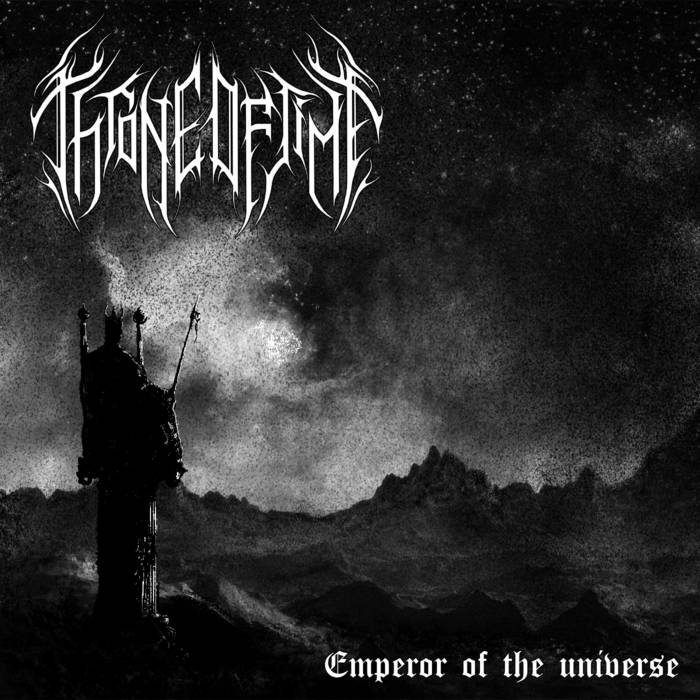
About ten years ago, a modest EP surfaced from a then completely obscure outfit called Throne of Time. It was a roughly cut stone: part basement demo, part unyielding conviction. Three years later came ‘Emperor of the Universe’, a title betraying more bravado than commercial instinct, and almost immediately after, the flame flickered out. Yet this brief tale continued to echo through the wings of the Dutch underground.
The names behind the project were anything but unknown: Daan Bleumink (Hellevaerder, Duindwaler), René Meijer (ex-Hellevaerder), and Dennis Onsia (Dystopia)—musicians who know how to pry open a wound musically and let it bleed in rhythm. For Bleumink, the project’s mastermind, it felt wrong to let the old tracks gather dust on a hard drive. So he re-recorded them, bolstered by several new compositions, with bassist Luuk Steemers (Hellevaerder, Infantry) joining to provide a solidity the original recordings had never possessed.
The result is a 1-hour-and-17-minute compilation that captures everything Throne of Time ever was: youthful ambition, erratic melancholy, warped idealism, and that hunger so often found in early projects, before life, logic, or simply time intervenes.
That Storm and Alex of Zwaertgevegt were quick to throw themselves at this material should surprise no one. Their drive not just to archive Dutch releases but to honour them with physical editions borders on the archaeological, like they alone know where to brush off the dust to reveal something of value. Throne of Time thus received a monument at last: small, unpolished, but honest and necessary.
But what does this ambitious project actually sound like? The answer lies somewhere between icy mountainsides and dusky pine forests: the North of the continent has been studied well. The Norwegian influences aren’t laid on thick, but drift like a cold draft through the entire record. Think the angular minimalism of Mayhem, the rusty, blackened fray of Darkthrone, and here and there a faint shimmer of Emperor, as if someone buried a keyboard line deep in the mix yet left the foundation with a subtle gleam.
I never heard the original demos, so a direct comparison isn’t possible. What is clear, however, is that Daan didn’t simply dust off old ideas, he reimagined them with care, reverence, and a stubborn kind of devotion. These new versions feel like the reconstruction of an ancient manuscript: the spirit preserved, the lines sharper, the ink deeper, the hand surer.
The result is a release that slips easily into the history of Dutch Black Metal, a forgotten chapter finally allowed into print. It doesn’t rewrite the genre, but it does complete a missing strip of the puzzle, an artefact belonging on the shelf of anyone who holds the Dutch underground close to a dark, beating heart.
And time is of the essence: only eighty exist. Wait too long, and you’ll be left with second-hand copies or stories from others, and that would be a shame for a project that has at last received the physical form it has deserved all these years.